
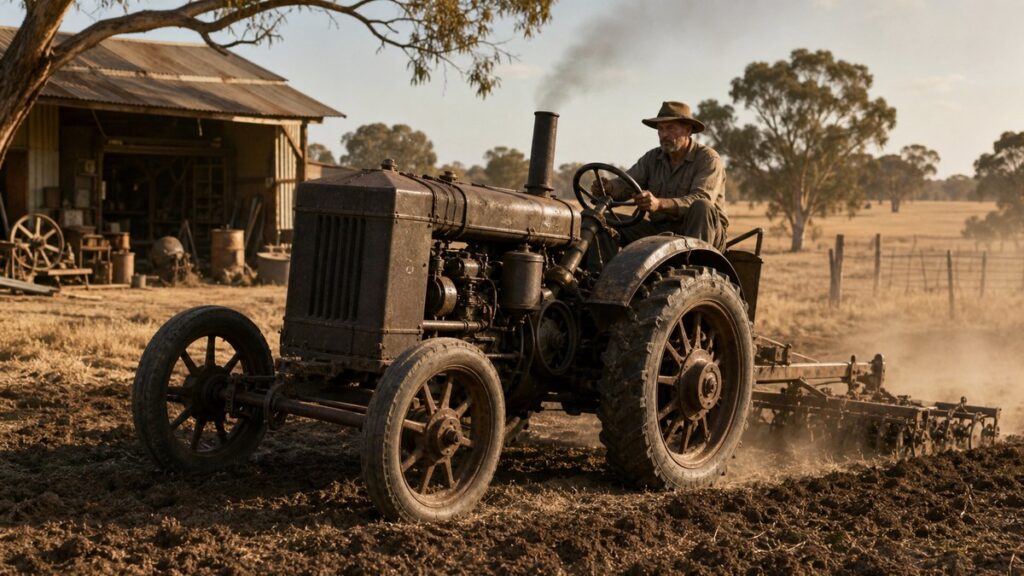
Ask most farm history buffs where the diesel tractor got its start, and you’ll hear names tied to the United States or Europe. The real answer sits much farther south, on a workbench in Australia, where a small company put diesel power on farm wheels in 1924 while the rest of the world was still burning kerosene and gasoline.
- The McDonald tractor, built in 1924, was the world’s first diesel-powered wheeled tractor, though it worked only within Australia.
- A.H. McDonald & Co. was the first firm to build a tractor entirely in Australia.
- Australian builders answered isolation and steep costs by engineering and casting their own parts from scratch.
A Little Company With a Big First
In 1924, a little-known outfit called A.H. McDonald & Company did something no other manufacturer had managed. It built a wheeled tractor powered by a diesel engine and put it to work in the field. That machine holds the title of the world’s first diesel-powered wheeled tractor, and it stayed almost entirely inside Australia’s borders.
The timing matters here. Diesel power was still a curiosity in 1924. That same year, a MAN diesel truck rolled out in Germany with direct-injection technology, so the idea of running heavy equipment on diesel was fresh and largely unproven. For a farm machine to lean on that fuel this early was a bold bet, and it came from a company most people outside Australia had never heard of.
McDonald & Co. earned another distinction along the way. It was the first firm to build a tractor entirely in Australia, rather than assembling imported pieces. The success of its Model E-B gave the company a foundation to build a whole range of machines, and that homegrown approach shaped everything that followed.
Why Australia Became a Tractor Laboratory
Building farm equipment on the other side of the world came with real headaches. Australian makers faced long distances, thin supply chains, and high costs for anything shipped in from abroad. When a part broke or a component simply wasn’t available, waiting months for a replacement wasn’t practical.
So they made their own. Australian tractor builders got comfortable casting, machining, and engineering the pieces they needed, turning isolation into a reason to invent rather than an excuse to fall behind. That self-reliance pushed the industry toward designs you wouldn’t expect from such a small market.
Some of those early machines featured four-wheel drive and four-wheel steering, ideas that wouldn’t show up on many American tractors until decades later. The harsh conditions Down Under, from baked ground to wide-open acreage, demanded traction and maneuverability, and local builders delivered both while the rest of the industry was still catching up.
The Engineering Story Behind the Iron
The diesel-first title is the headline, but the mindset behind the McDonald machine is what really sticks with you. These were farmers and mechanics solving problems with whatever brains and metal they had on hand, and they landed on solutions that the bigger, better-funded companies took years to reach.
That same spirit shows up whenever people dig into old iron today. Collectors and restorers still chase down rare machines, trace serial numbers, and rebuild engines that predate most modern farms. If you’ve ever fallen into a late-night search for used tractors near me and ended up reading about some obscure brand that made only a handful of units, you already understand the pull. Machines like the McDonald are the deep end of that hobby, the ones that quietly changed what a tractor could be.
Plenty of short-lived brands never got their due. Companies came and went, some producing a single model for just a year before the economics caught up with them. The McDonald stands out because its idea stuck. Diesel eventually became the standard for serious farm horsepower everywhere, which makes that 1924 machine less of a footnote and more of a starting line.
Give the Old Iron Its Due
Diesel power eventually won farmers over because it paired low-speed pulling strength with better fuel economy and long working life. Early engines could be noisy and stubborn, but they fit the steady, heavy loads of plowing and harvesting far better than delicate machinery. Restoring one today is a different challenge. Owners may have to machine a missing component, study faded manuals, or trade information with collectors across continents. That detective work is part of the appeal. Each running survivor preserves not just a rare tractor, but the practical engineering culture that let isolated workshops solve problems the global industry had barely begun to tackle.
History tends to hand credit to the loudest markets, and Australia’s early tractor makers rarely got a mention outside their home country. But the record is clear. A small company built the first diesel wheeled tractor in 1924, and its neighbors kept building with drive and steering systems that were years ahead of their time. Next time diesel power comes up around the shop, you’ll know exactly where to point. Not to Detroit or Germany, but to a modest workshop in Australia that got there first.
