
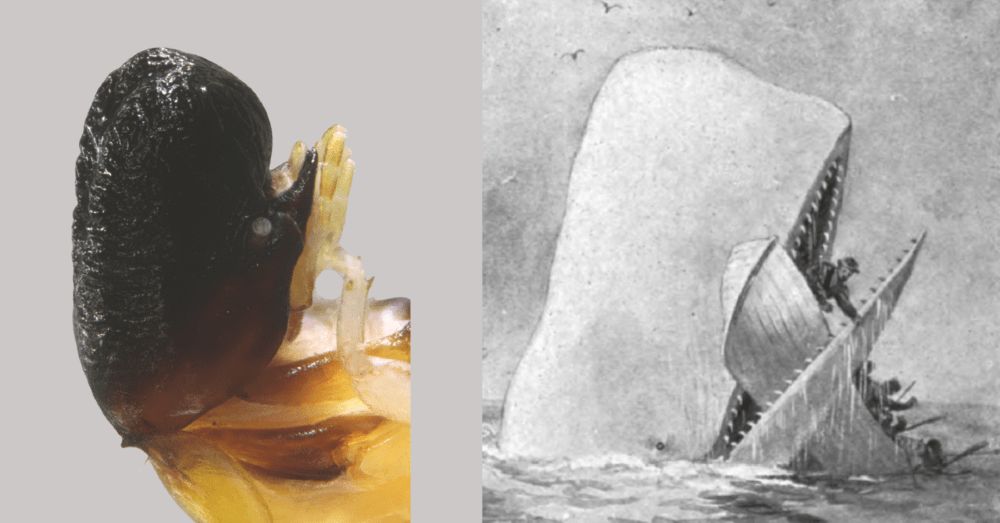
High in the treetops of French Guiana, a team of entomologists cracked open a piece of dead wood and found something that looked less like an insect and more like a character from 19th-century literature. The soldier termite staring back at them had a long, blunt, blocky head that was unmistakably whale-shaped, and the researchers couldn’t resist the comparison. They named it Cryptotermes mobydicki, and yes, it’s exactly as quirky as it sounds.
- A newly described termite species in French Guiana has a head shaped like a sperm whale’s.
- Researchers named it Cryptotermes mobydicki after Herman Melville’s famous literary whale.
- The insect is harmless to homes and lives only in dead wood inside the rainforest canopy.
A Canopy Discovery That Stopped Scientists in Their Tracks
High in the treetops of a South American rainforest, scientists identified a tiny soldier termite with a surprisingly whale-like appearance. The unusual insect caught the attention of an international team of researchers, who were struck by how different it looked from any known species.
The colony was tucked inside a dead tree standing about eight meters above the forest floor. That’s roughly 26 feet up, which explains how this strange little insect managed to stay hidden for so long. Canopy sampling is tough work, and plenty of microhabitats up there remain barely studied.
What really threw the team was the soldier’s anatomy. It has a long, rounded head and mandibles that are mostly hidden from view. Its shape closely resembles a sperm whale, the famous marine animal from Herman Melville’s novel, which inspired its name. According to Scheffrahn, the insect’s appearance was so unusual that researchers initially believed they might be looking at an entirely new genus.
Why the Moby Dick Comparison Actually Works
The whale nickname isn’t just a fun marketing angle. The physical parallels are genuinely striking when you line up the two creatures side by side. “The lateral view of the soldier’s frontal prominence and elongated head resembles the head of a sperm whale, and in both organisms, the mandibles are eclipsed by the head,” Scheffrahn said.
Lead researcher Rudolf Scheffrahn, an entomology professor at the University of Florida’s Institute of Food and Agricultural Sciences, noted that the whale’s eye and the termite soldier’s antennal socket even sit in comparable spots on the head. His coauthors agreed the playful name fit the weird little insect, following a tradition of whimsical scientific names like the ghost orchid or the Dumbo octopus.
For a soldier termite, the long head isn’t just for looks. Soldiers in the Cryptotermes genus typically use their heads as plugs, blocking tunnel entrances to defend the colony. Mobydicki appears to take that strategy to an extreme, hiding its mandibles entirely behind a bulky, forward-thrusting skull.
Where It Fits in the Termite Family Tree
This discovery brings the number of known Cryptotermes species in South America to 16. Genetic analysis shows that Cryptotermes mobydicki is closely related to other species found across the Neotropics, including populations in Colombia, Trinidad and the Dominican Republic. These findings offer new insight into how this group of termites has evolved and spread.
The specimens were collected near the Sinnamary River at Petit Saut in French Guiana back in 2016, but it took years of careful examination, DNA sequencing, and phylogenetic work before the team published the formal description in the journal ZooKeys in late 2025.
No Reason for Homeowners to Worry
If you just pictured a whale-faced termite chewing through your floorboards, relax. This one stays put in the wild. As a newly described drywood termite species, Cryptotermes mobydicki is no threat to homes or trade. Unlike other invasive termites that cause costly damage in parts of the southeastern United States, this species lives only in its rainforest habitat and does not spread beyond it.
Instead of being a pest, it plays a quiet role as a decomposer, helping break down dead branches high in the canopy and returning nutrients to the forest ecosystem. That wood eventually falls to the ground, where the recycling process continues.
What a Whale-Faced Bug Tells Us About Earth’s Hidden Biodiversity
Its unusual body structure highlights just how diverse termite species can be and points to how many organisms in tropical environments remain undocumented. Each new species adds to scientists’ understanding of biodiversity, especially in groups like termites, which include only about 3,000 known species worldwide.
The bigger takeaway is a humbling one. A three-millimeter insect with a face borrowed from one of literature’s most famous sea creatures was living eight meters above researchers’ heads for who knows how long before anyone thought to look up. If a whale-shaped termite can hide that well, imagine what else the canopy is still keeping to itself.
